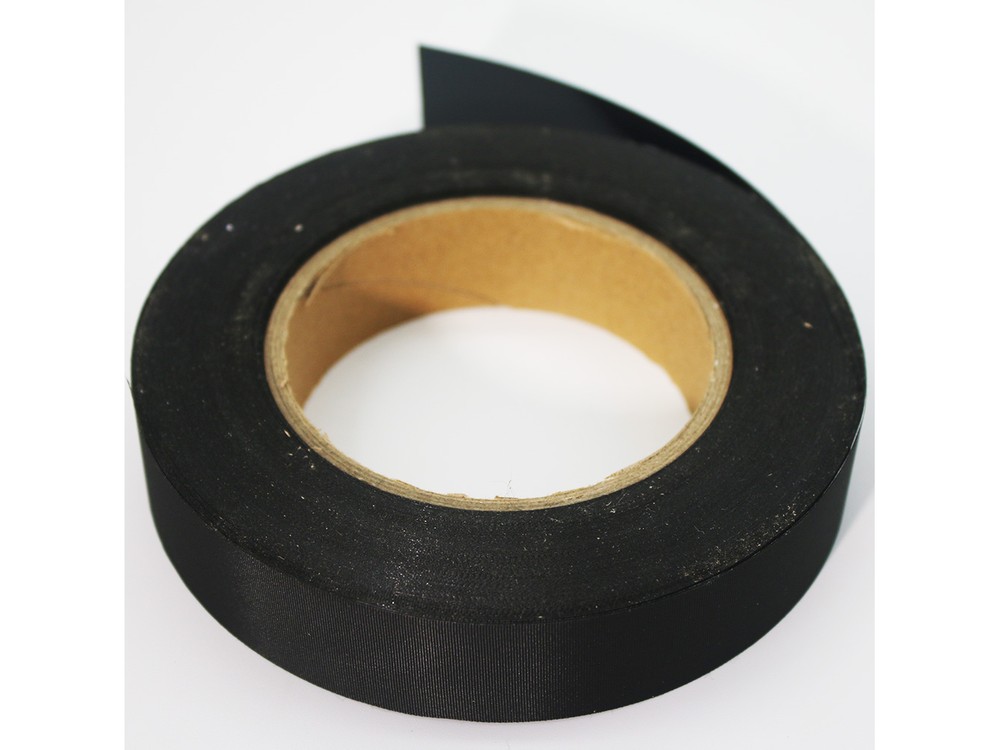
How to Source and Approve Light-Blocking Die-Cut Tape
Source light-blocking die-cut tape with a controlled drawing, exact-model evidence, sample gates and release checks. Send EJOY your RFQ.
Short answer: a useful quotation for light-blocking tape identifies the converted part as well as the material. A black roll, a clean-looking edge and a supplier statement of opacity do not approve the part that will reach your line. Keep one traceable chain: drawing revision, exact tape construction, evidence for that construction, sample build, your approval, then repeat-order controls.
This guide is for display frames, camera-module masks and optical housings. EJOY coordinates the candidate quotation, the samples and the document review once your requirements are confirmed; you stay responsible for defining and approving the finished assembly. It does not cover stage or photographic blackout use, which has a different specification and its own page. The tape is made by Anhui Yijiayi Technology Co., Ltd. (brand ONEI), and the manufacturing and optical-test side is written up in the manufacturer’s light-blocking manufacturing and optical validation guide; this page is the buying side.
1. Freeze the part identity before you ask for a price
Send a controlled drawing with the aperture, the outside dimensions, the datum, the adhesive side, the liner side and the application orientation. Say whether you need slit rolls, individual die-cuts or parts on a continuous liner, and whether the part has a pull tab, a kiss-cut or a through-cut and how it will be removed and placed. Mark the critical dimensions and let your engineering define their limits; do not substitute a catalogue thickness for the assembly gap you actually have.
Record the exact tape model, suffix, colour and construction revision when you know them. If you do not know a model, describe the optical task and the mechanical constraints. A competitor reference is a comparison input, not evidence of interchangeability, so ask each supplier to list every difference from the build you asked for.
2. Make suppliers quote the same requirement
| RFQ field | Your input | What the supplier must answer |
|---|---|---|
| Part identity | Drawing number and revision, dimensions, tolerances, format | The quoted drawing, the exact construction and any declared exception |
| Optical task | Through-material light, edge leakage or unwanted reflection; the light source and the acceptance rule | Which evidence already exists for the exact model and which tests remain |
| Bonding surface | The actual plastic, coated metal or glass, its preparation and the ageing sequence | The candidate adhesive and the scope of any substrate testing |
| Converting | Aperture, edge and particle requirements, liner, peel direction, placement method | The part build, the inspection method and the trial-sample configuration |
| Commercial basis | Forecast, order quantity, destination, required date | Unit basis, tooling, samples, MOQ, lead-time assumptions, packaging and quote validity |
Compare the price per agreed usable part and write down what each quote includes: liner, tooling, packing, test documents and any one-time work. Two equal roll prices do not deliver the same number of accepted parts. Keep material and converting charges visible where that helps the comparison. MOQ, sample availability and lead time are confirmed for your specific request in a dated quotation.
3. Review the evidence without borrowing another grade
Match each property to the quoted model, colour, thickness, adhesive, test condition and report revision. A quality-system certificate describes its organisation and scope; it does not establish the optical performance of any tape, and a material result does not by itself approve a die-cut part or a finished module.
What the manufacturer publishes today for its light-blocking models is limited, and it is better to know that before you build an approval plan around it:
| Model | Datasheet on the manufacturer’s site | Printed values |
|---|---|---|
| L012-193 | Yes, revision 2025-01-18 | Thickness 0.12 ± 0.01 mm; 180° peel ≥ 800 gf/inch; service temperature 80 °C; opacity ≥ 99.5% with no method stated |
| L020-193 | Yes, revision 2025-02-28 | Thickness 0.20 ± 0.01 mm; 180° peel ≥ 1000 gf/inch; service temperature 80 °C; opacity ≥ 99.5% with no method stated |
| L112-193, L120-193, L008-193, L108-193, Z1L020-193, Z1L120-193 | No datasheet published | Request model-level documents and ask what has actually been measured |
These are the manufacturer’s records from its published datasheets, not EJOY test data. No transmission, optical-density or reflectance figure is published for any of the eight models, so an optical limit has to be agreed and tested for the part you are buying; an opacity figure without a wavelength range, instrument and geometry cannot be compared with such a limit.
Standards help you say what was measured and how. ISO 29862 describes peel-adhesion methods, including adhesion to steel, to the tape’s own backing and of a liner to the adhesive; it is useful for specifying a peel value and says nothing about light blocking or adhesion to your surface. Where it applies to your programme, IEC 62595-2-1 covers electro-optical measurement of LED backlight units; it is a measurement method, not a certificate for this tape. Light-shielding tapes are also made on film backings, so do not treat the data of a film product as evidence for a cloth candidate; ask for the evidence of the material actually quoted.
4. Approve samples through separate gates
| Gate | What is reviewed | Release record |
|---|---|---|
| Material sample | The exact construction and the agreed optical and adhesion evidence | Sample ID, model, revision, accepted and open items |
| Converted part | Drawing fit, window alignment, edge condition, liner removal, placement | Part inspection with the controlled drawing and sample labels |
| Trial assembly | Your substrate, your assembly process and the relevant environmental sequence | Your module test and a written disposition |
| Pilot lot | Repeatability of part identity, packing, handling and the agreed checks | Lot approval linked to the signed sample and any outstanding deviation |
Keep a retained reference sample with its records. A signed appearance sample is not a performance specification, so state whether your approval covers only the material, the converted geometry, your assembly or all three, and do not release an unresolved deviation just because a shipment date is close.
5. Turn the approval into incoming and reorder controls
The purchase order should name the approved model, the part and drawing revisions, the roll or part format, the quantities, the evidence you require and the packaging. Agree the incoming inspection plan and the rules for nonconforming or quarantined material before shipment, using your own sampling plan; this page does not invent a universal sample size or acceptance number.
At receipt, compare labels and lot identifiers with the purchase order, the approved sample and the delivery documents. Inspect critical geometry, liner condition, contamination, packing damage and the agreed optical or adhesion checks. Ask for a certificate of analysis only where a controlled test-and-reporting arrangement exists: a document title does not show that every ordered property was measured.
6. Control changes and delivery responsibilities
Agree how a change of backing, adhesive, colour treatment, liner, converting process, site or packaging is notified and evaluated. Your engineering decides whether the change touches the existing approval and which tests are repeated; a visually similar replacement is not automatically approved.
Confirm the seller, the manufacturer, the owner of the technical documents, the shipping destination and who handles deviations. Take storage and shelf-life information from the controlled product documents rather than from a family statement, and put tooling ownership, delivery terms, document language and claim handling in the order agreement. EJOY confirms the commercial conditions for each quotation instead of publishing universal promises.
Request a documented candidate quotation
Send your controlled drawing, the actual bonding surface, the light-leak or reflection concern, any evidence you already hold and your sample-approval requirements, with the expected quantity, destination and decision date. We reply with a quotation that names the candidate model, the scope of its documents, the exceptions and the next validation step. Final suitability is approved through your own application process. Product page: light-blocking cloth tape.